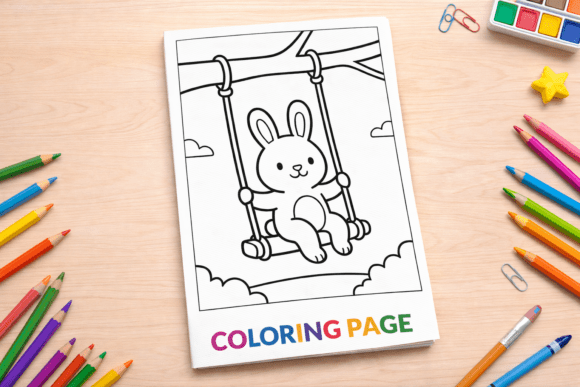
How to Use the Cute Bunny on Swing Coloring Page Successfully
A single coloring page might seem simple, but the Cute Bunny on Swing Coloring Page is far more than a casual printout. Whether you are an educator building a lesson plan, a seller creating a KDP activity book, or a parent looking for a quiet afternoon project, this downloadable asset holds real potential. Unfortunately, small mistakes in how you handle the file, format the print, or interpret the license can turn a productive project into a disappointment. Let’s walk through the most common pitfalls and how to avoid them so you get the full value from this cheerful rabbit illustration.
Understanding Your Digital Bundle Matters More Than You Think
When you download the bundle, you receive a PNG, JPG, PDF, and EPS file. It is easy to grab the JPG and print it immediately. That works, but it is not the best approach. Each file format serves a specific purpose, and ignoring that limits your options.
The JPG is a universal preview file. It is great for quick thumbnails or uploading to a drag-and-drop design tool, but it lacks the sharp precision required for high-quality print work. The PNG file gives you a transparent background, which is invaluable if you want to drop the bunny into a digital canvas like Procreate, GoodNotes, or Canva. You can color digitally without fighting white boxes around the image.
The PDF is your print-ready workhorse. Designed at 8.5x11 inches with 300 DPI resolution, it preserves the crisp, bold outlines exactly as intended. The EPS file is the hidden gem. Because it is a vector file, you can scale the bunny up for a poster or down for a bookmark without losing any quality. Relying solely on the JPG means you miss the flexibility and professional output the other formats provide.
Check These Details First
- Resolution: Confirm your software is using the file at 300 DPI. Lower settings cause jagged edges on the bunny’s ears and the swing ropes.
- Color Mode: These files are typically RGB. If you are sending to a commercial printer or uploading to Amazon KDP, convert to CMYK to avoid dull or shifted colors.
- Transparency: When using the PNG in a digital app, check that the transparent areas are intact. A stray white fill can ruin the clean line art effect.
Taking two minutes to open and inspect these files saves you from printing blurry pages or struggling with incompatible formats later.
Licensing and Commercial Use: Where Most Sellers Get Stuck
The bundle includes commercial use rights. This is a green light for creators, but it is easy to misinterpret what that actually permits. The most frequent mistake is assuming you can resell the raw, unaltered files on Etsy or as a standalone KDP book. You cannot. Commercial use typically means you may incorporate this page into a transformative product, not simply redistribute the original files.
A transformative product means you combine the coloring page with other content, add value, and create something new. For example, using the Cute Bunny on Swing Coloring Page as one of thirty pages in a “Spring Activity Book for Kids” is perfectly acceptable. Selling it as a single, standalone PDF with no additional content likely violates the license terms.
Another overlooked detail is the difference between use in a physical product versus a digital product. If you sell a printed coloring book on Amazon, the license covers you. If you sell the exact PDF you downloaded on Etsy, you are essentially competing with the original creator using their own work. Always read the included license file carefully. If you are unsure, add more original content to your compilation. More pages, a cover design, and original activities make your product undeniably transformative.
Print Setup Errors That Ruin a Perfect Page
A beautiful line art design loses its charm the moment it prints poorly or gets cropped. The most common issue is ignoring bleed, trim margins, and paper quality. The Cute Bunny on Swing Coloring Page is formatted perfectly for a standard 8.5x11 inch sheet. If you drop it into a different trim size without adjusting the canvas, parts of the swing or the bunny’s ears may get cut off.
For home printing, avoid lightweight copy paper. Markers bleed through easily, and crayons struggle to lay down vibrant color on thin stock. Cardstock or premium matte paper makes the design pop and holds up better to enthusiastic coloring. Always print a test page before running a large batch for a classroom or event.
For KDP sellers, the margin issue is critical. KDP requires safe zones for text and images. The bunny sits centrally, but the swing ropes reach upward. Ensure your book interior setup uses the correct trim size and that you are not scaling the JPG to fit a smaller format. Use the PDF directly or open the EPS in a vector editor to reposition elements if needed. Printing at less than the specified 300 DPI results in soft, pixelated lines that look unprofessional.
Printing Checklist for Clean Results
- Always use the PDF file for the most accurate print dimensions.
- Check your printer settings for “Actual Size” or “100% Scale” to prevent unwanted scaling.
- Select a paper weight of at least 24 lb (90 gsm) for coloring activities.
- For KDP, compress your interior using PDF/X-1a standards to avoid upload errors.
Matching the Design to the Right Audience
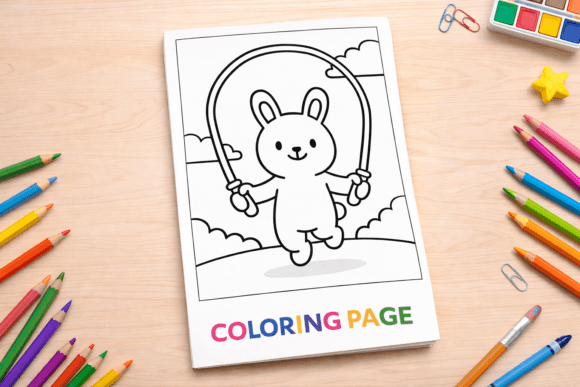
This particular coloring page features bold outlines and a simple, charming subject. It is ideally suited for toddlers, preschoolers, and young learners. Trying to market it to older children or adults who prefer intricate mandalas or detailed scenes will lead to poor reviews and low satisfaction. The beauty of this design is its clarity and ease of use.
Teachers and homeschoolers value pages like this because they support fine motor skill development and color recognition. The bunny on a swing is a relatable, calming image that fits nature, spring, and playground themes. If you are bundling this for educational use, pair it with simple tracing sheets or letter recognition activities for the word “swing.”
For Etsy sellers, position the page specifically. Use phrases like “easy coloring for toddlers,” “preschool animal activity,” or “simple spring printable.” Buyers searching for these terms are actively looking for exactly this style. Mislabeling it as an “intricate nature scene” will mismatch customer expectations and hurt your click-through rate.
Presentation and Mockups Make or Break Sales
Whether you are selling on Etsy or simply sharing with an audience, how you present the page matters. A raw, uncolored JPG as a thumbnail tells a buyer nothing about the experience. They cannot visualize the finished product. This is a lost opportunity.
Create a clean, colored mockup of the bunny. Use soft pastels or bright crayon-style colors that match the intended audience. Show the bunny happily swinging on a bright blue swing with a green tree branch above. A single colored example communicates the joy and relaxation this activity provides. Also, include a screenshot of the file bundle showing the PNG, EPS, PDF, and JPG files. This immediately conveys value and helps buyers understand they are getting a versatile pack, not just one image.
For KDP, the “Look Inside” feature is your best asset. Make sure the first few pages of your book are the most attractive spreads from your compilation. If the Cute Bunny on Swing Coloring Page is the strongest design, feature it early. A weak preview leads to abandoned purchases.
Practical Ways to Extend the Page’s Value
Do not stop at print-and-color. This line art can serve more purposes with a little creativity. Teachers can enlarge the EPS file to create a coloring poster for a classroom bulletin board. Parents can print the page on sticker paper and let kids color and stick the bunny onto a homemade card. Digital sellers can incorporate the PNG into a digital journal or tablet-based coloring book for GoodNotes.
Another overlooked opportunity is using the page as a storytelling prompt. Ask children to color the bunny and then write a short sentence about where it is swinging. This turns a simple art activity into a literacy exercise. The bold, simple lines also make this page an excellent candidate for scissor practice. Print it on sturdy paper and let young learners cut around the bunny shape. Always look for ways to repurpose the asset rather than treating it as a one-time printable.
Ideas for Expanding Use
- Combine multiple copies into a themed coloring book for a class party favor.
- Use the PNG in a digital whiteboard app for group coloring during online lessons.
- Print on watercolor paper and let older children practice wet-on-dry techniques, using the black lines as a guide.
Overlooking Vector Capabilities Is a Lost Opportunity
Many casual users ignore the EPS file because they do not have Adobe Illustrator. Free tools like Inkscape or Affinity Designer open vector files easily. Once open, you can change the line thickness, adjust the size without quality loss, or even separate the swing from the bunny. For example, you might want a larger bunny and a smaller swing for a specific layout. With the vector file, this takes seconds. With the JPG, it requires messy cutting and resampling that degrades quality.
If you are designing a book cover and want the bunny centered but slightly smaller to fit text, the vector file gives you that control. Overlooking this capability means you are leaving professional flexibility on the table.
One Final Review Before You Publish or Print
Before you upload that book to KDP or hit print on twenty copies for a classroom, take a final look at your setup. Confirm the file is the correct orientation. Check that no watermarks or test marks appear in the margins if you edited the file in a free tool. Verify that the commercial license covers your exact use case, especially if you are selling on multiple platforms. A quick review prevents costly reprints or listing takedowns.
The Cute Bunny on Swing Coloring Page is a simple, well-crafted asset that performs beautifully when handled correctly. Know your file formats, respect the licensing, match the product to the right audience, and present it professionally. That straightforward approach turns a single printable into a reliable resource for classrooms, businesses, and creative projects.